The Hidden Impact of Taxes on Long-Term Wealth
When investors think about growing their wealth, the conversation usually begins with investment returns.
Market performance, portfolio allocation, and economic trends tend to dominate financial discussions. While these factors certainly matter, there is another element that can have an equally powerful — and sometimes even larger — impact on long-term financial outcomes:
Taxes.
Over time, taxes can quietly reduce a meaningful portion of investment returns. Without thoughtful planning, investors may find themselves paying significantly more than necessary throughout retirement.
For many individuals approaching retirement, tax planning for retirement income can be just as important as investment strategy. Managing withdrawals from retirement accounts, coordinating taxable and tax-deferred assets, and understanding required minimum distributions can all influence how much income remains available to spend.
In many cases, the difference between a reactive approach and a coordinated tax strategy can amount to hundreds of thousands of dollars over a lifetime.
At Riverstone Wealth Planners, we incorporate tax awareness into the broader financial planning process. We work with individuals and families throughout Chester, New Jersey and Morris County to help coordinate investment strategy, retirement income planning, and long-term tax considerations.
Understanding how these elements interact can help investors make more informed financial decisions over time.
Why Tax Planning Matters for Retirement
Many financial events can create tax consequences, including:
• withdrawals from retirement accounts
• selling investments in taxable brokerage accounts
• Roth conversions
• Social Security benefit timing decisions
• inherited retirement accounts
• required minimum distributions (RMDs)
Without a coordinated strategy, these events can sometimes push investors into higher tax brackets, increase Medicare premiums, and reduce the amount of income available to spend in retirement.
By contrast, thoughtful planning may allow investors to better manage when income is recognized and how withdrawals are structured, which can potentially improve long-term tax efficiency.
The illustration below highlights how strategic tax planning can influence financial outcomes over time.
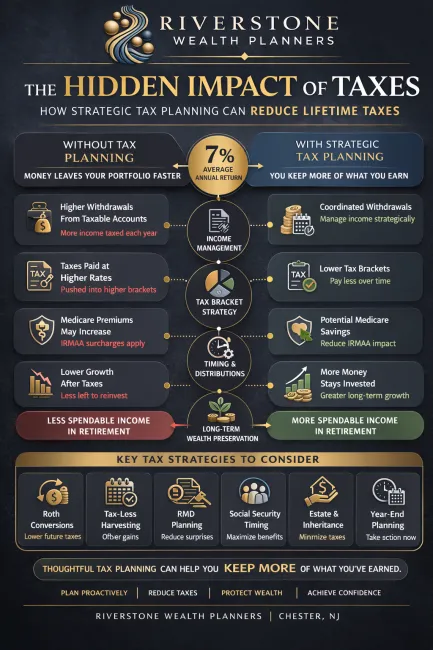
While every financial situation is unique, the underlying concept is straightforward:
Tax planning is not just about one year — it is about coordinating financial decisions across decades.
Reactive vs. Strategic Tax Planning
One of the most common challenges investors face is that tax decisions are often made year-by-year, rather than as part of a long-term financial strategy.
For example, an investor might:
• withdraw funds from retirement accounts without considering future tax brackets
• delay planning around required minimum distributions
• overlook Roth conversion opportunities during lower-income years
• unintentionally trigger higher Medicare premiums due to income spikes
When financial decisions are evaluated in isolation, the cumulative tax impact can become significant over time.
A more coordinated approach evaluates taxes across multiple years or even decades, helping investors understand how today’s decisions may influence future tax outcomes.
What This Series Will Cover
In the coming weeks, we will publish several articles exploring tax planning topics that frequently impact investors and retirees.
Topics in the Riverstone Tax Planning Series will include:
• The Hidden Tax Risks of Large IRA Balances
• When Roth Conversions Make Sense — and When They Don’t
• The Widow’s Tax Penalty and Planning Considerations
• Tax Planning Opportunities During Market Volatility
• What to Do When You Inherit an IRA
• Year-End Tax Planning Strategies Investors Should Consider
Each article will focus on one specific area where thoughtful planning may help investors make more informed financial decisions.
A Long-Term Perspective on Taxes
Effective tax planning rarely happens in a single year. Instead, it often involves coordinating financial decisions across many years.
Examples of strategies investors may evaluate include:
• managing withdrawals across taxable, tax-deferred, and Roth accounts
• evaluating Roth conversion opportunities
• planning around required minimum distributions
• coordinating investment decisions with tax brackets
• understanding how income levels may affect Medicare premiums
When these elements are considered together, investors may be able to create a more tax-efficient long-term financial strategy.
Frequently Asked Questions About Tax Planning
Why is tax planning important for retirement?
Tax planning helps investors manage when income is recognized and how withdrawals are structured. Without a strategy, taxes on retirement accounts, investment gains, and required minimum distributions can reduce the amount of income available to spend during retirement.
What is tax-efficient retirement income planning?
Tax-efficient retirement planning involves coordinating withdrawals from different types of accounts — such as taxable brokerage accounts, traditional retirement accounts, and Roth accounts — in a way that may help manage taxes over time.
When should investors begin thinking about tax planning?
Tax planning often becomes especially important during the years leading up to retirement. During this time, investors may evaluate strategies such as Roth conversions, withdrawal sequencing, and income coordination.
Can tax planning help reduce lifetime taxes?
While no strategy can eliminate taxes entirely, thoughtful planning may help investors manage when income is recognized and potentially reduce the overall tax impact across retirement years.
Final Thoughts
Taxes are one of the few financial factors investors may be able to influence through thoughtful planning.
While no strategy eliminates taxes entirely, understanding how financial decisions interact with the tax code can help investors make more informed choices over time.
In the next article in this series, we will explore one of the most common planning challenges investors face:
the hidden tax risks associated with large traditional IRA balances.
This material is for informational purposes only and should not be considered individualized financial or tax advice. Individuals should consult with a qualified financial professional or tax advisor regarding their specific situation.