The Ongoing Tax Planning Nobody Told You About
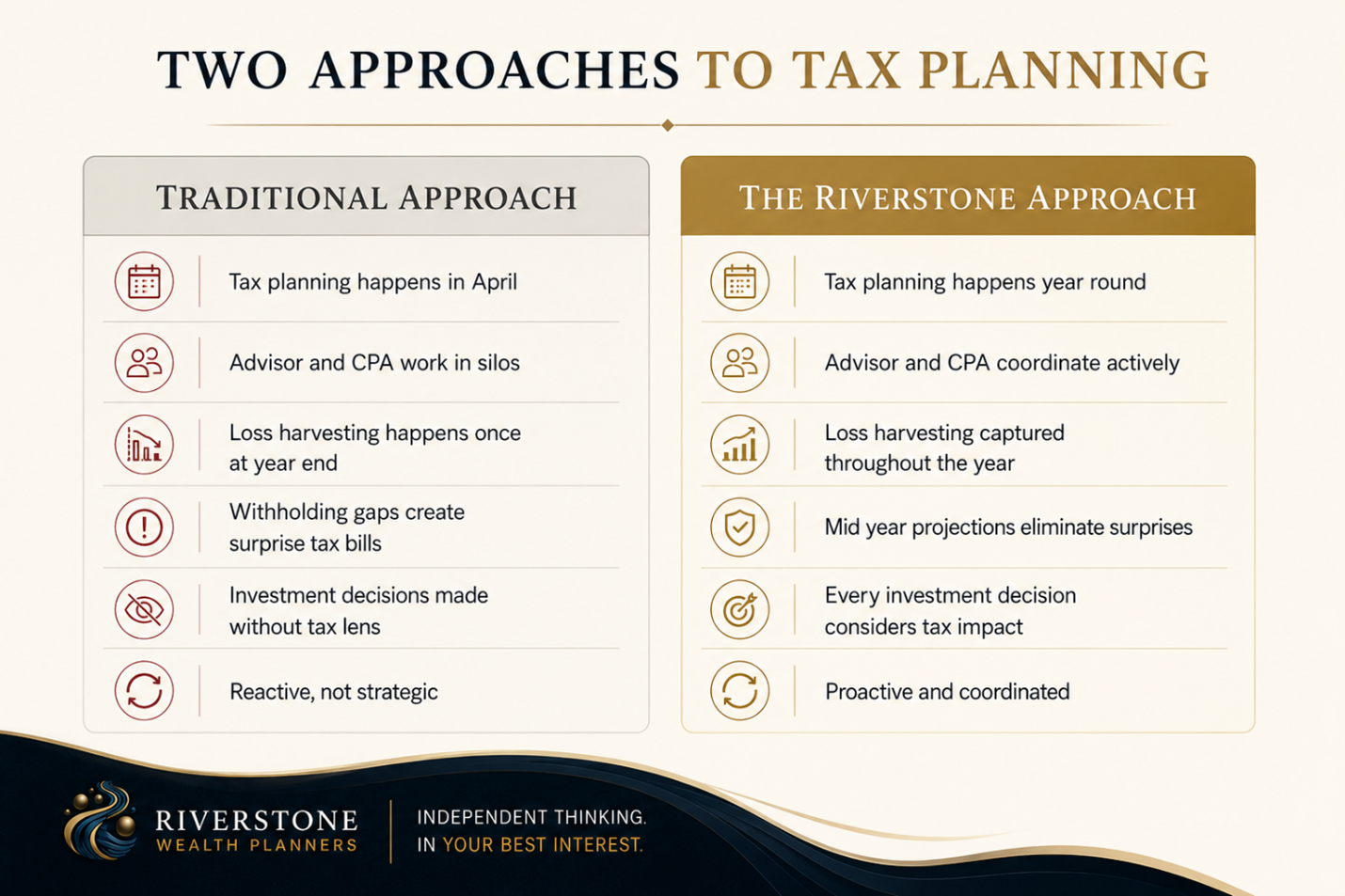
When most people think about tax planning, they think about April. The CPA calls. Documents get gathered. A return gets filed. The result is either a refund or a bill, neither of which felt entirely under your control.
That's not tax planning. That's tax reporting.
Real tax planning happens in the months before the return is filed. It happens when investment decisions get made, when income events are scheduled, when charitable gifts are timed, when losses are harvested. By the time April arrives, the consequential decisions have already been made or missed.
This post is written for the clients I work with most often. Pharma and life sciences executives in New Jersey with significant equity compensation, business owners approaching or navigating a liquidity event, and independent women managing major life transitions including divorce, widowhood, and inheritance. Each of these situations creates complex tax exposure that a once a year conversation will never fully address.
At Riverstone Wealth Planners, tax planning is an ongoing process throughout the year, in coordination with your CPA, with the goal of making sure there are no surprises when your return gets prepared.
"Ask Your CPA"
If you've worked with an advisor at a large national brokerage firm, you've probably heard some version of this line. You bring up a tax question and the response is some variation of "we don't do taxes" or "you should ask your CPA about that."
There's a reason for that response. Most advisors at large firms operate under compliance and business model restrictions that effectively prevent them from engaging substantively on tax planning. They're trained to manage investments and refer everything tax related to someone else. The result is that you have an advisor managing your portfolio without considering the tax consequences of their decisions, and a CPA filing your return without seeing the investment strategy that drove the numbers.
That gap is where most of the value gets lost. Tax planning is too connected to investment decisions to outsource entirely. When we harvest a loss, that's an investment decision with tax consequences. When we evaluate a Roth conversion, that's a tax decision with investment consequences. When we choose where to hold a particular type of investment, that's both at the same time.
We don't replace your CPA. We coordinate with them. And we bring the tax lens to every investment decision rather than referring it away.
Year Round Tax Loss Harvesting
Most advisors who talk about tax loss harvesting do it once a year, in December, as part of a year end scramble. We approach it differently.
Loss harvesting is a year round activity at Riverstone. Markets create opportunities throughout the year, not just in the fourth quarter. A volatile February. A sell off in May. A correction in September. Each of those moments creates potential losses that can be captured and used to offset gains elsewhere in your portfolio, lower your tax bill, and improve your after tax returns over time.
For pharma executives, year round loss harvesting becomes especially powerful in years when RSUs vest or options get exercised. Captured losses can offset the gains generated from concentrated stock diversification, allowing executives to reduce company stock exposure without the full tax hit.
For business owners approaching a liquidity event, harvested losses can be accumulated and deployed strategically against the gain generated when the business sells. This is one of the most overlooked planning opportunities for owners in the year or two leading up to a transaction.
For women in transition who are receiving meaningful assets through divorce, inheritance, or settlement, harvested losses provide flexibility to rebalance the inherited portfolio into a more appropriate allocation without triggering unnecessary tax exposure.
Direct Indexing for Tax Efficiency
One of the tools that makes year round tax loss harvesting genuinely effective is direct indexing. Rather than buying an index fund or ETF that holds hundreds of stocks as a single position, direct indexing gives you direct ownership of the underlying stocks within the index.
The tax benefit is significant. With a traditional index fund, you only have one position to evaluate for tax loss opportunities. With direct indexing, you have hundreds. Individual stocks within the index can be at a loss even when the broader index is up, and those losses can be harvested while maintaining your overall market exposure.
For clients with meaningful taxable assets, this approach can generate ongoing tax alpha that compounds over time. It's particularly valuable for executives with concentrated company stock, business owners with sudden liquidity, and anyone managing a large taxable portfolio.
Charitable Giving Strategy
For clients who are charitably inclined, we actively educate on the tax efficient ways to give. The right strategy depends on your situation, but the tools available are significantly more powerful than most people realize.
Donor advised funds allow you to make a large charitable contribution in a single year, take the deduction immediately, and then distribute the gifts to charities over time. This is particularly useful in high income years where bunching multiple years of charitable giving into a single tax year creates a meaningful deduction that wouldn't otherwise be available. Executives with large bonus or RSU years use this constantly. Business owners deploy this in the year of a sale.
Gifting appreciated securities directly to charity rather than cash eliminates the capital gains tax that would otherwise be owed on the appreciation. For executives with concentrated stock positions, business owners with appreciated company shares, or anyone with long held investments carrying significant gains, this is one of the most powerful tools available.
For clients with more complex situations, charitable trusts can provide income to the client during their lifetime while ultimately benefiting a charity. These structures require coordination with your estate attorney but can serve multiple planning objectives at once, including providing income to a recently widowed spouse or generational wealth transfer for business owners.
Tax Efficient Investment Analysis
Beyond loss harvesting, we analyze every investment from a tax viewpoint. Not all investments are equally tax efficient. Some generate significant ordinary income that gets taxed at your marginal rate. Some generate qualified dividends and long term capital gains that receive preferential treatment. Some create complex tax filings through K-1s. Some are best held in tax deferred accounts. Some are best held in taxable accounts.
Most advisors don't think about this systematically. They buy what they think is a good investment and leave the tax consequences to your CPA to sort out at year end. We think about asset location alongside asset allocation. Which investments belong in which type of account, given the tax treatment of each, matters enormously over a multi decade investment horizon.
Coordination With Your CPA
The work above is most effective when it happens in coordination with your CPA throughout the year. We maintain open lines of communication with our clients' tax professionals, share information actively, and plan together so that decisions made in one office are visible in the other.
This is different from what most clients have experienced. Typically the financial advisor and the CPA operate in isolation. The advisor manages the portfolio. The CPA prepares the return. Nothing connects the two except the client, who isn't expected to be the one coordinating across professional disciplines.
We function differently. Your CPA hears from us during the year, not just at tax time. We share projections, flag potential issues, and ask their input before we make decisions that will affect your return. The result is a smoother, more coordinated tax outcome and fewer surprises at filing time.
Reading the Return Ourselves
A core part of how we work is that I read every client's tax return personally. Not just the summary your CPA emails over, but the full return. Looking at the actual return tells me things that no summary can capture. Where are the tax inefficiencies in the current setup? What deductions are being missed? What income is being taxed at higher rates than it needs to be? Where are the opportunities that nobody has pulled forward?
Reading returns at this level is something most advisors either can't do or don't make time for. After nearly two decades of doing this, I'm confident in my ability to read a return thoroughly and identify planning opportunities that get missed when the work is left to a once a year conversation.
Common Questions About Ongoing Tax Planning
How is ongoing tax planning different from what my CPA does?
Your CPA prepares your tax return based on what happened during the year. Ongoing tax planning shapes what happens during the year so the return reflects the most efficient outcome possible. The two are complementary, not redundant.
I'm a pharma executive with RSUs and options. What kind of tax planning do I actually need?
If your compensation includes RSUs, stock options, and deferred compensation, you almost certainly need year round tax planning that goes beyond what a typical advisor provides. Withholding on equity compensation is structurally inadequate for executives in higher brackets, multiple income events stacking in a single year creates exposure most people don't see coming, and decisions about when to exercise options or diversify company stock have significant tax consequences that need to be modeled in advance.
I'm a business owner preparing to sell my company. How does tax planning fit in?
The tax planning you do in the one to two years before a sale can dramatically affect what you keep from the transaction. Strategies including installment sales, charitable trusts, qualified opportunity zone investments, and accelerated loss harvesting can all be deployed pre-transaction to reduce the eventual tax bill. These strategies have to be set up in advance. They can't be added after the deal closes.
I recently went through a divorce and received a settlement. What should I be thinking about from a tax standpoint?
A divorce settlement often triggers a significant rebalancing of the portfolio you receive. Doing that rebalancing without considering the tax consequences can generate unnecessary capital gains. Working with an advisor who plans the rebalancing alongside the tax picture, ideally with your CPA involved, can save substantial money in the first year alone.
What is direct indexing and why does it matter?
Direct indexing means owning the individual stocks within an index rather than owning the index through a fund. The tax benefit is that individual stocks can be sold at a loss to offset gains elsewhere, even when the overall index is up. For high income earners and clients with significant taxable assets, this approach can generate meaningful tax savings over time that index funds and ETFs simply can't match.
Can I do this kind of planning with my existing advisor at a large brokerage firm?
In most cases the answer is no. Most advisors at large national brokerage firms operate under restrictions that prevent them from engaging substantively on tax planning. If your current advisor responds to tax questions by referring you to your CPA, you don't have an advisor doing tax planning. You have someone managing your investments separately from your tax situation.
Does this kind of planning cost more?
Our fee structure is the same whether or not we're doing extensive tax planning work for you. Ongoing tax planning is part of how we work, not an add on service. The clients who get the most value from working with us are the ones who lean on us across their full financial life, tax planning included.
What This Means in Practice
The clients who get the most out of working with Riverstone are the ones who lean on us for tax planning year round rather than treating it as a tax season concern. The conversations we have in June about a potential Roth conversion strategy. The phone call in September flagging an opportunity to harvest losses ahead of a planned charitable gift. The November coordination call with your CPA to make sure quarterly estimates are sized correctly. The January planning meeting that maps out the year ahead.
None of this happens automatically. It happens because someone is paying attention and treating tax planning as the year round activity it actually is.
If your current tax situation feels reactive rather than proactive, or if you've been surprised by your tax bill in any of the last few years, reach out directly. The first conversation is straightforward and there's no obligation beyond it.
Bill Clinton, CFP®, CIMA®, CPWA® Riverstone Wealth Planners Chester, NJ 908-888-6906 Bill.Clinton@LPL.com
Securities and advisory services offered through LPL Financial, a registered investment advisor, Member FINRA/SIPC.