What to Do When You Inherit an IRA
Part of the Riverstone Tax Planning Series
Inheriting an IRA from someone you love is one of those situations where the financial complexity arrives at exactly the wrong moment.
You are grieving. You are managing an estate. You are fielding calls from attorneys and accountants and family members. And somewhere in the middle of all of that, someone hands you a document that says you are now the beneficiary of a retirement account, and you need to make some decisions.
Those decisions matter more than most people realize. The rules around inherited IRAs changed significantly in 2020, and in my experience working with clients throughout Morris County and northern New Jersey, the new rules are still widely misunderstood — even by people who consider themselves financially informed. Getting this wrong can result in unnecessary taxes, penalties, and a significantly smaller inheritance than you should have received.
This article is about making sure that doesn't happen to you.
The rules changed in 2020 and most people don't know it
Before 2020, beneficiaries who inherited an IRA had the option to take distributions over their own life expectancy. This was commonly called the "stretch IRA" strategy, and it was powerful. A 45-year-old who inherited a $500,000 IRA could spread distributions over 35 or 40 years, allowing the account to continue growing tax-deferred for decades while keeping annual taxable distributions relatively small.
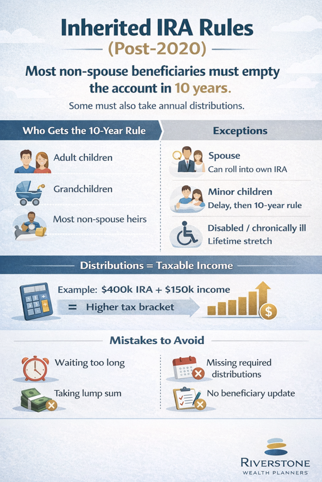
The SECURE Act, which passed in late 2019 and took effect in 2020, largely eliminated that option for most non-spouse beneficiaries. The new rule is called the 10-year rule, and it requires most inherited IRAs to be fully distributed within 10 years of the original owner's death.
That sounds manageable on the surface. Ten years feels like a long time. But there is a critical nuance that the IRS clarified in 2022 that catches many people off guard: if the original account owner had already begun taking Required Minimum Distributions before they passed, the beneficiary must also take annual distributions during the 10-year period, not just distribute everything by year 10.
The practical implication is significant. A beneficiary who assumed they could let the account grow for 9 years and then take a lump sum in year 10 may actually be required to take distributions every year — and the penalty for missing a required distribution is steep.
Who the 10-year rule applies to
The 10-year rule applies to most non-spouse beneficiaries, including adult children, grandchildren, siblings, and other individuals. There are important exceptions worth knowing.
Surviving spouses have considerably more flexibility. A spouse who inherits an IRA can roll it into their own IRA, treat it as their own account, and apply their own RMD rules going forward. This is almost always the most tax-efficient option for a surviving spouse and one of the first things I work through with clients who have lost a partner.
Minor children of the original account owner are also partially exempt. They can use their life expectancy to calculate distributions until they reach the age of majority, at which point the 10-year rule kicks in for the remaining balance.
Disabled or chronically ill beneficiaries, and beneficiaries who are within 10 years of the original owner's age, also qualify for different treatment. These are called Eligible Designated Beneficiaries, and they retain the ability to stretch distributions over their life expectancy.
Everyone else — which in practice means most adult children and grandchildren inheriting from a parent or grandparent — falls under the 10-year rule.
Why the tax impact is bigger than it looks
Here is where I see clients get surprised.
An inherited IRA doesn't feel like income. It feels like an inheritance — something that was given to you, not something you earned. But every dollar distributed from an inherited traditional IRA is taxed as ordinary income in the year you take it. And if you are in your peak earning years when you inherit, those distributions are being added on top of your existing salary, bonus, and other income.
A beneficiary who inherits a $400,000 IRA and is already earning $150,000 per year faces a real tax problem if they take large distributions without planning around them. Depending on how distributions are timed across the 10-year window, a meaningful portion of that inheritance could be taxed at 32% or higher.
The goal of thoughtful inherited IRA planning is to spread distributions in a way that minimizes the marginal rate applied to each dollar. That might mean taking larger distributions in years when other income is lower, coordinating with Roth conversion decisions in your own accounts, or timing distributions around significant income events like retirement, a job change, or the sale of a business.
It requires looking at the full 10-year picture, not just the current tax year.
Spousal inherited IRAs deserve special attention
I work with a significant number of independent women here at Riverstone Wealth Planners, including many who have lost a spouse and are navigating inherited retirement accounts for the first time. This is one of the areas where having a trusted advisor matters most.
A surviving spouse who inherits an IRA has choices that other beneficiaries don't. Rolling the inherited IRA into their own account gives them full control over when distributions begin and how they are structured. It also means the account is subject to their own RMD schedule, which may not begin until age 73 — potentially years later than if they left it as an inherited IRA.
There are situations where a surviving spouse might actually benefit from keeping the account as an inherited IRA rather than rolling it over, particularly if they are under 59½ and need access to the funds without the 10% early withdrawal penalty that applies to their own IRA. This is a nuanced decision that depends heavily on age, income needs, and the overall financial picture.
The point is that options exist, and the right choice is not always the obvious one. Getting a second set of experienced eyes on this decision before making it is almost always worth the time.
Common mistakes I see with inherited IRAs
In nearly 19 years in this business, I have seen the same mistakes made over and over again with inherited IRAs. They are almost always the result of moving too quickly or assuming the rules are simpler than they are.
Assuming the old rules still apply. Many beneficiaries, and unfortunately some advisors, are still operating under pre-SECURE Act assumptions. If someone tells you that you can stretch distributions over your lifetime without confirming your beneficiary category and the original owner's RMD status, get a second opinion.
Missing annual distributions when required. The IRS has provided some penalty relief in recent years as the industry caught up to the new rules, but that relief is not permanent. Missing a required annual distribution from an inherited IRA can trigger a penalty of up to 25% of the amount that should have been distributed. This is entirely avoidable with proper planning.
Taking a lump sum distribution without considering the tax impact. This happens most often when a beneficiary is unaware of their options or feels overwhelmed by the complexity. Taking the entire balance in a single year can result in a tax bill that consumes a significant portion of the inheritance. Spreading distributions thoughtfully across the 10-year window almost always produces a better outcome.
Failing to name a successor beneficiary. Once you inherit an IRA, you become the account holder. Naming your own beneficiaries on that account is important and often overlooked in the fog of grief and estate administration.
The first steps when you inherit an IRA
If you have recently inherited an IRA, or believe you may in the coming years, here is what I would recommend.
Do not take any distributions until you understand the rules that apply to your specific situation. Identify what type of beneficiary you are — spouse, eligible designated beneficiary, or a standard non-spouse beneficiary subject to the 10-year rule. Determine whether the original account owner had already begun taking RMDs, because this affects whether you are required to take annual distributions during the 10-year period. And then build a distribution plan across the full window that minimizes your tax exposure based on your own income picture.
None of this is complicated once you have the right information. But it does require looking at the inherited account in the context of your entire financial life, not in isolation.
Working with a financial advisor in Morris County on inherited IRA planning
For individuals and families throughout Chester, Mendham, Far Hills, Bernardsville, Morris County, and the broader northern New Jersey area, inherited IRA decisions are some of the most consequential tax planning conversations I have. They arrive at difficult moments, they involve significant sums, and the rules are genuinely complex.
If you have inherited an IRA or are expecting to, I would encourage you not to wait. The decisions made in the first year after an inheritance set the trajectory for everything that follows. Getting it right from the start is considerably easier than trying to correct course later.
Riverstone Wealth Planners is located at Chester Woods Professional Park, 385 Route 24, Suite 3E, Chester, NJ 07930. We work with clients throughout Morris County, the NJ/NY metro area, and nationally through a fully virtual planning experience.
Frequently Asked Questions
What is the 10-year rule for inherited IRAs? The 10-year rule, established by the SECURE Act in 2020, requires most non-spouse beneficiaries to fully distribute an inherited IRA within 10 years of the original owner's death. If the original owner had already begun taking Required Minimum Distributions, the beneficiary must also take annual distributions during the 10-year period.
Do spouses have different rules for inherited IRAs? Yes. A surviving spouse has considerably more flexibility than other beneficiaries. They can roll the inherited IRA into their own account, apply their own RMD schedule, and in many cases defer distributions significantly longer than a non-spouse beneficiary could.
Are inherited IRA distributions taxable? Yes. Distributions from an inherited traditional IRA are taxed as ordinary income in the year they are taken. This is why the timing and size of distributions across the 10-year window matters so much from a tax planning perspective.
What happens if I miss a required distribution from an inherited IRA? Missing a required annual distribution can trigger a penalty of up to 25% of the amount that should have been distributed. The IRS has provided some relief in recent years, but this relief is not guaranteed going forward.
Where can I find a financial advisor in Morris County NJ to help with an inherited IRA? Riverstone Wealth Planners, based in Chester, New Jersey, works with individuals and families throughout Morris County and northern New Jersey on inherited IRA planning, retirement tax strategy, and wealth management. You can schedule a complimentary conversation at the link above.
This material is for informational purposes only and should not be considered individualized financial, tax, or legal advice. Individuals should consult with a qualified financial professional, tax advisor, or attorney regarding their specific situation. Advisory services are offered through Riverstone Wealth Planners. Securities and advisory services may be offered through LPL Financial, a registered investment advisor and member FINRA/SIPC. Tax laws are subject to change, and the impact of any strategy will vary based on individual circumstances.