Putting It All Together: Why Coordination Is the Real Strategy
Over the past five posts, we've covered the individual components of executive compensation in detail. RSUs and why the decision doesn't end at vesting. Stock options and why timing matters more than most executives realize. Deferred compensation and the question almost nobody thinks to ask. The structural withholding gap that creates surprise tax bills. And the concentration risk that builds quietly when nobody is managing it.
Each of those topics matters on its own. But if there's one idea that ties the entire series together, it's this.
The biggest financial mistakes executives make are rarely about any single decision. They're about decisions made in isolation, without anyone looking at how the pieces interact.
The Coordination Problem
Think about what a typical year looks like for a director or VP level pharma executive. RSUs vest in February. The annual bonus pays in March. Stock options are sitting unexercised with expiration dates approaching. A deferred compensation distribution is scheduled for later in the year. The 401(k) is on autopilot. Company stock has been accumulating for years without a diversification plan.
Each of those items was designed by a different department, administered by a different system, and explained to you at a different point in your career. Nobody sat down and showed you how they interact. Nobody ran the math on what they all add up to in a single tax year. Nobody noticed that the scheduled deferred comp distribution, combined with everything else, was going to push you into a bracket that made an option exercise particularly expensive that year.
That's the coordination problem. And it's far more expensive than any individual mistake.
What Coordination Actually Looks Like
A coordinated approach to executive compensation planning isn't complicated in concept, but it does require someone who is looking at the full picture rather than one piece at a time.
It starts with a clear inventory. What compensation components do you have, what are the vesting and distribution schedules, what are the tax characteristics of each, and what is the total picture of your financial situation including investments, debt, insurance, and estate planning?
From that inventory, a calendar emerges. When do decisions need to be made and by when? Deferred compensation elections happen before the year begins. Option exercises need to be timed relative to other income events. RSU vesting is fixed but what you do afterward is a choice. Estimated tax payments have quarterly deadlines.
From that calendar, a tax projection takes shape. What does total income look like across the year? Where are the gaps in withholding? What planning moves, like charitable giving with appreciated stock or harvesting losses to offset gains, make sense given the overall picture?
And from that projection, the investment strategy gets aligned. How much company stock is being accumulated through vesting and how does that affect overall portfolio concentration? What does a sensible multi year diversification plan look like given the tax environment?
None of these questions are answered in isolation. They're answered together, because the answer to each one affects the others.
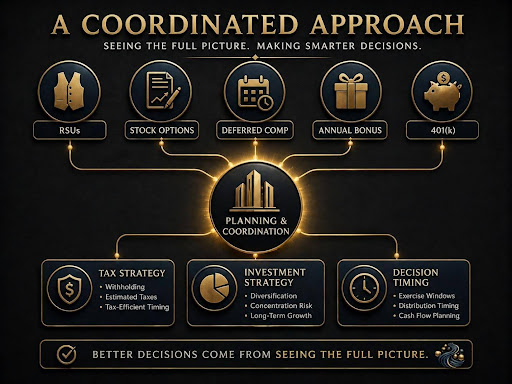
The reason most executives don't have a coordinated approach is that most advisors aren't built to provide one.
A generalist advisor at a large wirehouse typically focuses on managing assets not looking at your deferred compensation plan documents or timing your option exercises around your bonus.
Your CPA is preparing your tax return. They may flag issues after the fact, but they're generally not proactively modeling scenarios before decisions are made. And even when they are, they're looking at the tax picture without necessarily seeing the investment and planning picture.
HR and your company's benefits team explain how your compensation programs work. They don't advise on strategy.
The result is that most executives have multiple professionals touching pieces of their financial lives without anyone coordinating across all of them. The withholding gap exists because nobody looked at the full income picture. The concentration builds because a diversification plan wasn't built. The option expiration surprises because nobody was tracking it against the broader calendar.
What Experience Has Taught Me
After nearly two decades of working with executives on these decisions, the pattern is consistent.
The executives who come out ahead financially aren't necessarily the ones who made every individual decision perfectly. They're the ones who had someone looking at the whole picture, asking the right questions at the right time, and coordinating across tax, investment, and planning decisions rather than treating each one as a separate transaction.
In my opinion, that's a different kind of advisory relationship than most executives have experienced. It requires an advisor who understands executive compensation at a deep level, who is willing to engage with your CPA and estate attorney rather than work around them, and who is thinking about your situation proactively rather than reactively.
It also requires an advisor with the credentials to actually do the work. My CFP® certification provides the planning foundation. My CIMA® designation provides the investment management depth and my CPWA® provides the specific expertise in executive compensation and high net worth complexity. Those three together represent a credential profile built for the situations executives like you are navigating.
A Final Thought on This Series
I wrote this series because the executives I work with in Morris County and throughout northern New Jersey consistently come to me having made the same preventable mistakes. Not because they're not sophisticated. They are. But because nobody ever sat down and showed them how everything fits together.
If something in this series raised a question about your own situation, that's the right signal to act on. These are not decisions that get easier with time. Options expire. Distribution elections lock in. Concentration builds. Tax bills arrive.
The executives who build real wealth from their compensation packages are the ones who treat these decisions as connected rather than isolated. If you want to understand what a coordinated approach to your compensation would actually look like, reach out directly. The first conversation is straightforward and there's no obligation beyond it.
Bill Clinton, CFP®, CIMA®, CPWA® Riverstone Wealth Planners Chester, NJ 908-888-6906 Bill.Clinton@LPL.com
This material was created to provide accurate and reliable information on the subjects covered but should not be regarded as a complete analysis of these subjects. It is not intended to provide specific legal, tax or other professional advice. The services of an appropriate professional should be sought regarding your individual situation.
Riverstone Wealth Partners and LPL Financial do not provide legal or tax advice. Please consult with your tax or legal advisor regarding your personal situation.