Start Before You Sell
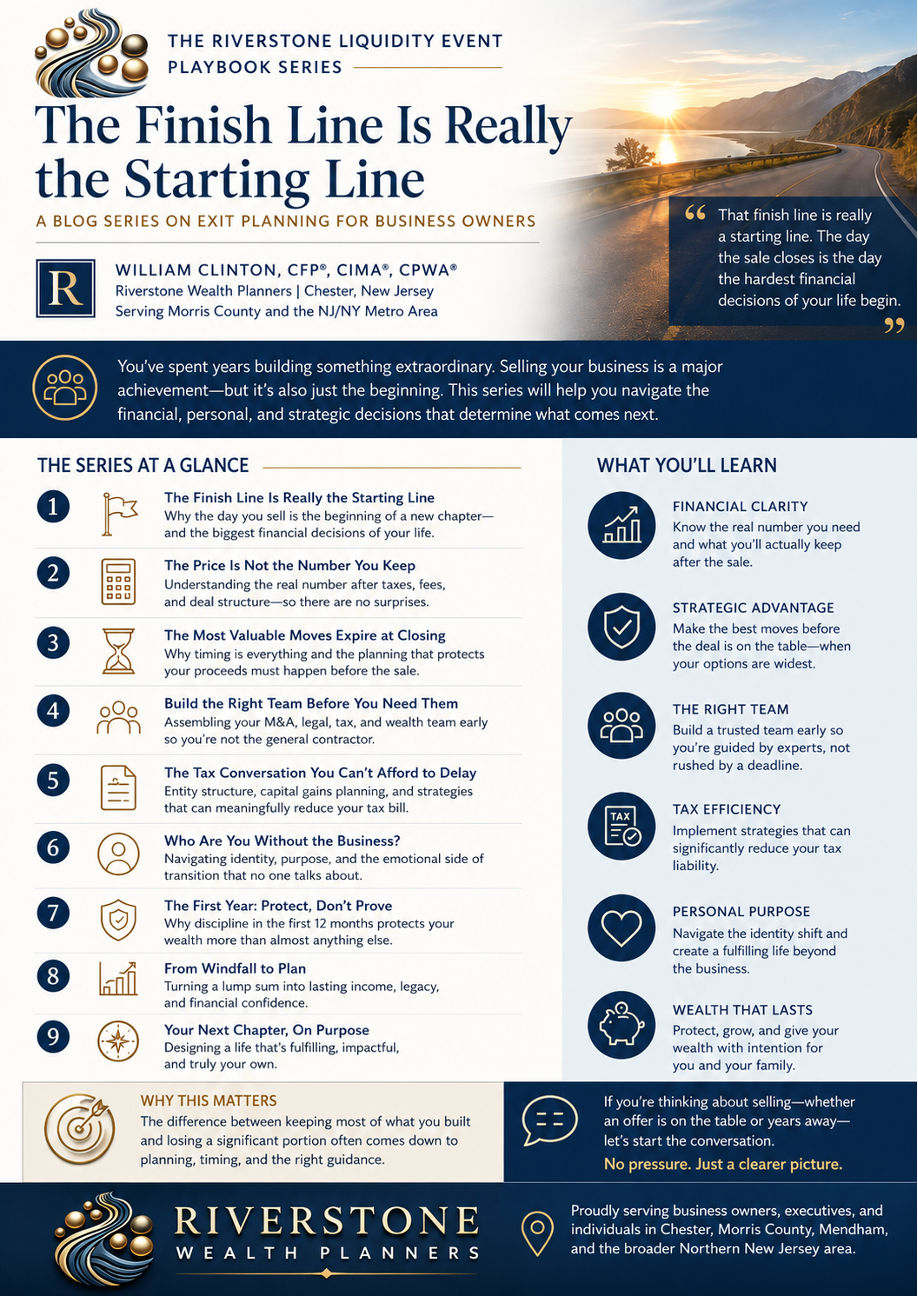
William Clinton, CFP®, CIMA®, CPWA® | Riverstone Wealth Planners Chester, New Jersey | Serving Morris County and the NJ/NY Metro Area
The Riverstone Liquidity Event Playbook Series
The single most expensive mistake business owners make when they sell is starting too late.
Not a bad negotiation. Not the wrong buyer. Timing. By the time most owners think to bring in planning help, an offer is already on the table, the deal is moving, and the most valuable moves are already behind them, out of reach. The work that protects the most money has to happen while the business is still yours and still privately held, often years before you sign anything.
This is the post I wish every owner read the day they first wondered whether they might sell someday, because someday is exactly when this work should begin.
Why early is everything
When your business is privately held and harder to value, you have flexibility. That flexibility is the raw material for nearly all of the planning that protects your eventual proceeds. The structure of the entity, the way ownership is arranged, the groundwork for how the sale will be taxed, the steps that move value to family or to charity on favorable terms, all of it works best, and sometimes only works at all, when there is real time before a sale.
Once a deal is in motion, the picture freezes. A buyer is at the table, the price is becoming real, the value is no longer ambiguous, and the clock is running. The options that were available when a sale was a distant idea start disappearing one by one. By the time the wire hits your account, the planning window is not narrowing anymore. It is closed.
This is the part that stings for owners who started late. The advice they get after the sale is often perfectly good advice. It is just advice they can no longer act on, because the moment to use it has passed. Good guidance at the wrong time is worth very little.
Two owners, the same business
Picture two owners with nearly identical companies, both planning to sell eventually.
The first starts preparing three years out. There is time to get the books into clean, defensible shape, to organize the structure of the business sensibly, to lay the groundwork that lowers the eventual tax, and to think through how the proceeds will support the rest of her life. When a buyer finally comes, the business shows well, diligence goes smoothly, and the planning that protects her money is already in place. She negotiates from a calm, prepared position, and she knows in advance exactly what she needs to walk away with.
The second owner waits until a buyer appears, then scrambles. The books get cleaned up in a rush under the buyer's scrutiny. The structural and tax moves that needed lead time are no longer on the table. The proceeds land before there is any plan for where they go. He may well sell for a similar headline price, yet he keeps less of it, and he makes the biggest financial decisions of his life under pressure and on someone else's clock.
Same business. Possibly the same price. A very different outcome. The only variable that changed was when they started, and that variable is almost entirely within your control.
What starting early actually looks like
Starting early does not mean putting the business up for sale. It means getting ready, quietly, well before you need to.
It means knowing what your business might realistically be worth and what you would actually keep after taxes and costs, so the number does not blindside you later. It means getting your financial house, your books, and your records in the kind of order a serious buyer expects to see, which also tends to raise what they are willing to pay. It means assembling the right people around you before you need them in a hurry. And it means doing the planning that lowers the eventual tax and protects the proceeds while the door to that planning is still open.
None of this requires you to be selling next year. Most of it is most powerful precisely when a sale is still several years out. You are not committing to anything. You are making sure that when the day comes, on your timeline or someone else's, you are ready to keep as much of what you built as the law allows.
Know your number before you know your price
Here is a question most owners cannot answer when they first consider selling, and it is the most important one of all. How much do you actually need this sale to net in order to fund the rest of your life the way you want to live it?
Owners tend to fixate on the price, on getting the highest figure a buyer will pay. That matters. But the price only means something in relation to your number, the amount that, once it is invested and managed, actually supports your family, your lifestyle, and your goals for the decades after you stop working. A high price that still falls short of your number is a problem. A merely good price that clears it with room to spare is a genuine success.
You can only find your number by building a real plan well before the sale: what your life costs, what you want it to look like, what the proceeds will need to generate, and how taxes and time factor in. This is the part the deal team does not handle. Your investment banker works to get you the best price. Your attorney papers the transaction. Neither one tells you whether the result is actually enough for the life you want to live. That is the wealth planning side of the table, and it is the side that decides whether the sale is a true win for you rather than just a closed deal.
When you know your number early, everything downstream gets clearer. You can tell which offers genuinely work and which only look good on the surface. You know whether you can afford to wait for something better. And you walk into the most important negotiation of your life knowing precisely what you need to walk away with.
Why owners wait, and why it costs them
The reasons owners wait are completely understandable. You are heads down running the company. There is always something more urgent than planning for an event that might be years away. And there is a natural instinct to deal with the sale when there is actually a sale to deal with.
The trouble is that the instinct is backwards. The sale is the deadline, not the start. By the time there is a deal to react to, the highest-value work is already off the table. I have watched owners leave a meaningful portion of their life's work on the table, not because they negotiated poorly, but simply because no one helped them prepare in time. It is one of the quieter and more avoidable losses I see in this work.
There is also an upside to starting early that has nothing to do with taxes. Owners who plan ahead sell from a position of strength. They are not forced into a rushed deal by health, burnout, or a buyer's timeline. They can wait for the right offer, walk away from the wrong one, and make decisions with a clear head rather than under pressure. Preparation does not just protect your money. It gives you control over one of the most important transactions of your life.
The takeaway
If you remember one thing from this entire series, remember this one. The best time to start planning for the sale of your business is long before you intend to sell it. The owners who keep the most and stress the least are almost always the ones who began early, while every option was still open.
If selling is anywhere on your horizon, even as a someday, that is the right moment to start the conversation. I work with business owners, executives, and individuals navigating major financial transitions across Chester, Morris County, Mendham, and the broader northern New Jersey area, and an early conversation carries no pressure, only a head start.